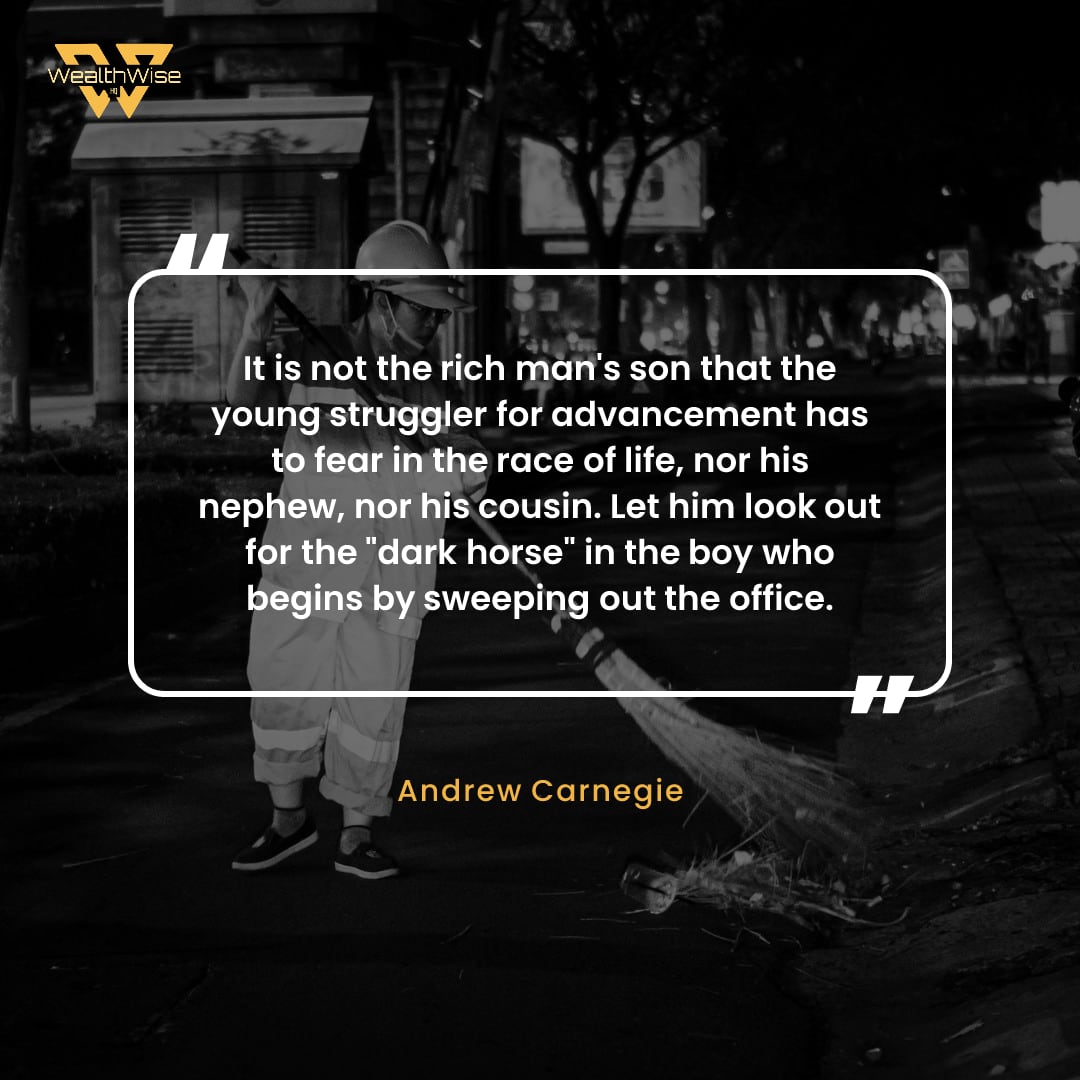
Personal Reflection:
When I hear this quote, I picture two young people starting out in the same company on the same day. One arrives with a famous last name, a network of introductions, and the quiet confidence of someone who has never had to wonder how the bills get paid. The other arrives with a broom. And Carnegie says: if you're worried about competition, don't watch the first one. Watch the one with the broom.
That always lands with me, because so much of our anxiety about money and success is comparison anxiety. We look sideways at the people who seem to have gotten a head start — the inheritance, the connections, the degree we couldn't afford — and we decide the race was rigged before we laced up. And sometimes it is uneven. I won't pretend otherwise. But Carnegie, who watched plenty of advantaged young men come and go, noticed something that still holds true: advantage without hunger tends to fade, and hunger without advantage tends to compound.
The kid sweeping the office isn't impressive on day one. That's the whole point. He's learning where everything is. He's hearing how the business actually works. He's noticing which customers call back and which don't, which habits make the place run and which waste everyone's time. Nobody is watching him, so he isn't performing — he's absorbing. By the time anyone thinks to take him seriously, he already understands the building better than the people who only ever walked through the front door.
I think this is one of the most honest things anyone has ever said about money and mobility. Progress usually starts in a job, a role, or a season that feels beneath the life you pictured. The side work you took on. The entry-level position. The months you spent rebuilding after something fell apart. Those stretches feel like waiting rooms, but they're actually classrooms — if you treat them that way.
The same is true of our financial habits. The person who starts with a small, unglamorous amount and never misses a month is the dark horse. Nobody writes articles about them. Their progress is invisible for a long, boring while. But they're learning something the big-windfall crowd often never learns: how to be consistent when nothing exciting is happening. That skill outlasts almost every advantage you can be handed.
What I also love here is the freedom in it. If the dark horse is the one who begins by sweeping out the office, then your starting point isn't a verdict. It's just a starting point. You don't need permission, a benefactor, or the perfect conditions. You need to be the person who shows up, pays attention, and does the task in front of you a little better than it needs to be done.
And there's a gentle warning tucked in, too. If you've already gotten some advantages — education, a stable home, a career that found you early — don't mistake the head start for the finish. Comfort is a slow leak. The moment we stop learning, stop sweeping, stop staying curious about the work, somebody behind us is quietly closing the gap.
So my takeaway isn't outwork everyone. It's simpler: stop auditioning for the race and start running it. Be the one who notices things. Be the one who does the small job with care. Be the one whose results show up years later and surprise everybody.
The dark horse rarely looks like much at the starting line. That's exactly why nobody sees them coming.
3 Reflection Questions for You:
Where in your life are you comparing your starting line to someone else's finish line — and what is that comparison costing you?
What's the "sweeping the office" work in your current season, and how could you do it with more attention this week?
If someone looked at your habits instead of your résumé, would they bet on you as the dark horse? Why or why not?